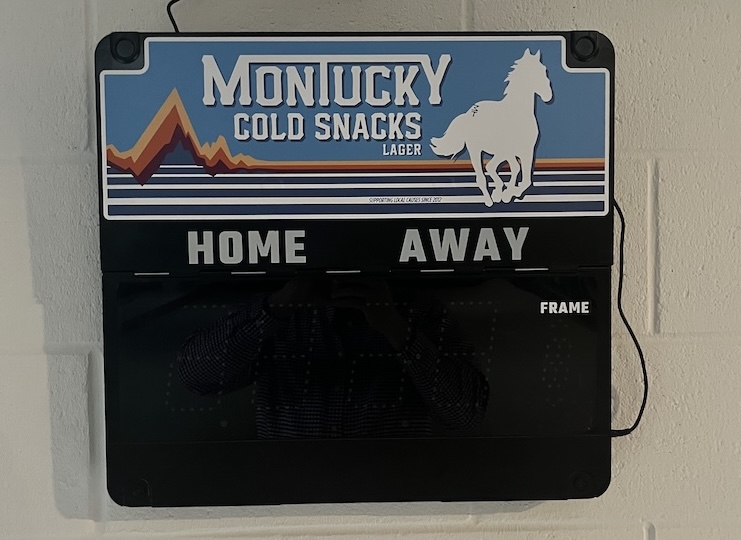
Chicago Bocce Club has three great-looking Montucky-branded Score Titan scoreboards thanks to a sponsorship from Montucky.
There is just one problem:
They were built for baseball.
Not bocce.
In baseball, a scoreboard is usually controlled from one central place. In bocce, that's not really how things work. Players typically update the score themselves without relying on a central scorekeeper.
The Score Titan hardware itself was actually a pretty good fit.
Home score? Check.
Away score? Check.
Inning? That's basically a frame.
It had a bright display, Bluetooth connectivity, and nearly everything we needed to show a bocce score.
What it didn't have was a good plan for self-service bocce scoring (it came with an iPhone/Android baseball app instead).
So Chicago Bocce Club asked me:
Can you design a hardware controller for these scoreboards?
Step 1: Hack the Bluetooth interface
Using Python and the Bleak Bluetooth library, we scanned for nearby Bluetooth Low Energy devices and found about 50 devices in the room. That made it quite hard to narrow down at first as every phone, individual AirPod, computer, Apple watch, etc. was broadcasting.
I narrowed things down by taking inventory and turning a scoreboard on and off.
Once we were confident we had the right device, we saw that the Score Titan exposed several services and characteristics (i.e. pieces of data that can be manipulated).
I used the Score Titan iPhone app to set known values on the scoreboard, then inspected what I could see over Bluetooth.
Change the home score.
Read the Bluetooth values.
Change the away score.
Read them again.
Change the inning (in bocce that would be the frame).
Look for what changed.
Repeat.
Eventually, patterns started emerging.
I identified the Bluetooth services corresponding to the home score, away score and frame.
Reading values was the first breakthrough.
I could now connect directly to the scoreboard and read what was being displayed.
Next I needed to know: Could values easily be manipulated?
Step 2: Write a program
I wrote a small Python program and sent new values directly to the scoreboard.
And the physical Score Titan scoreboard changed to:
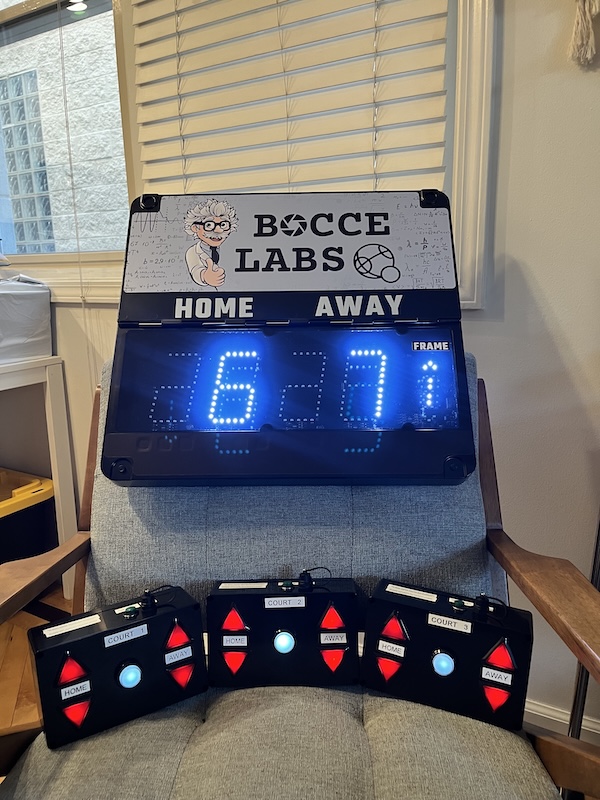
2 – 5 (frame 3)
At that point, my computer was talking directly to a baseball scoreboard that had originally been designed to communicate with an iPhone app.
Step 3: Build a physical control box
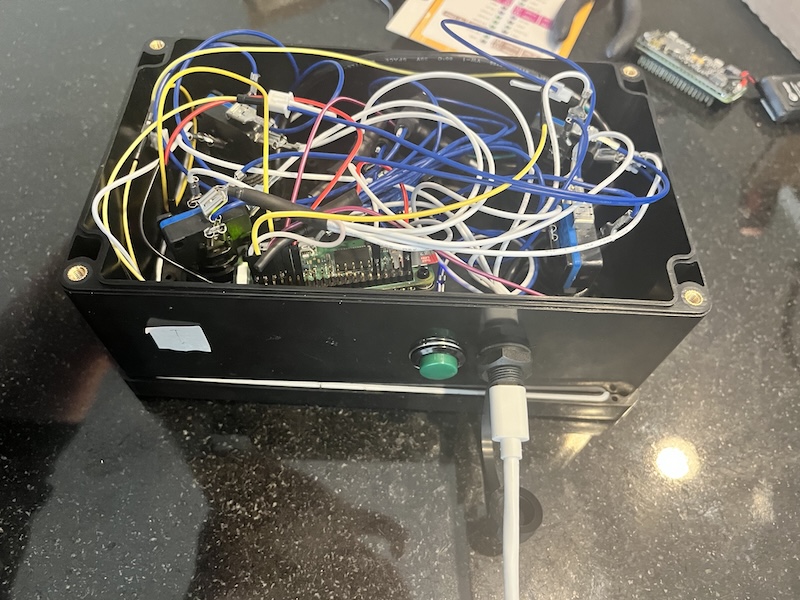
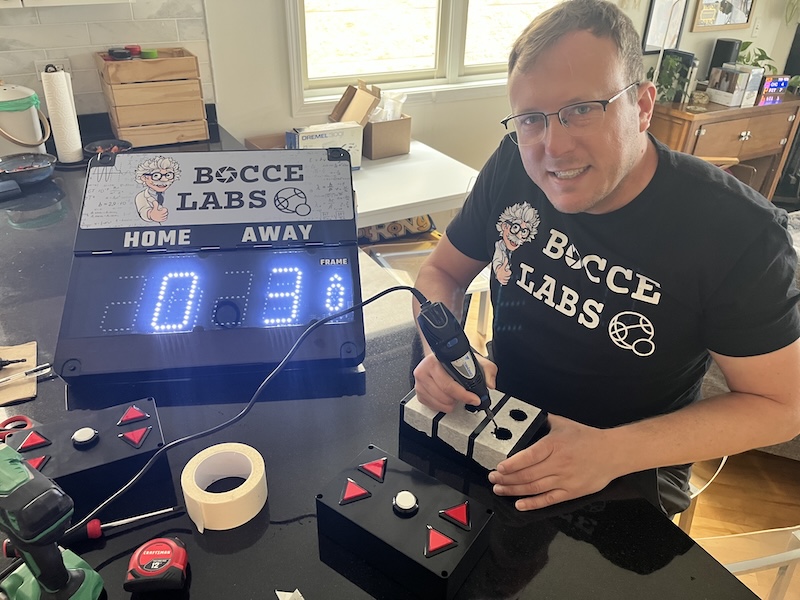
This is where I had to brush off my electrical engineering skills.
I conceived a box with:
- 5 buttons: (1) Home Up, (2) Home Down, (3) Away Up, (4) Away Down, and (5) Clear
- 5 LED lights
- 1 battery
- 1 USB-C bulkhead charging port
- 1 Brain (i.e. a Raspberry Pi with WiFi, Bluetooth, and 3V/5V GPIO pins running Linux)
I then ordered parts, made a prototype, and tested it.
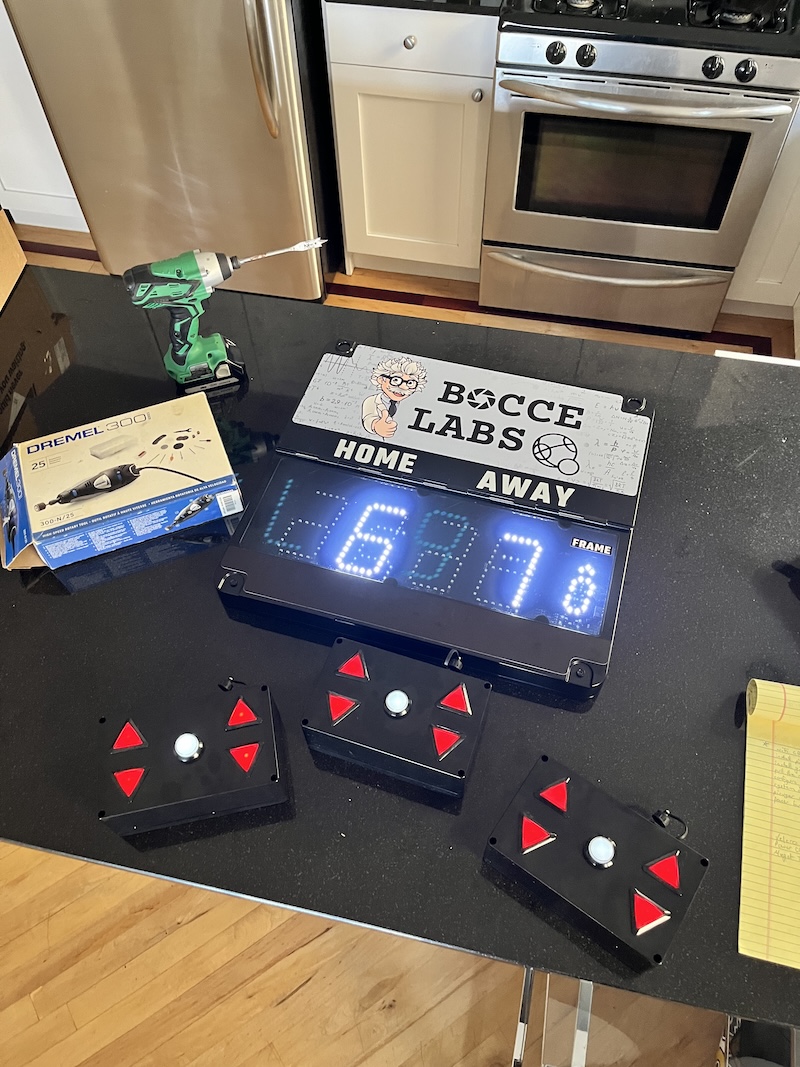
From there, I assembled 3 scoreboard controllers, programmed them, and thought I was done.
That's when I realized something was missing...
A power button!
I definitely didn't want the operator to reach in to a box full of wires to touch a tiny little button on the circuit board. So I overnight shipped 3 buttons (distinct from the score/clear buttons), wired them in, tested, and was ready to deploy.
Step 4: Install the control boxes at Chicago Bocce Club
Next, I conducted a site visit at Chicago Bocce Club and located the nearest power source on the ceiling. I ordered cabling, magnet tape, velcro, and other installation supplies.
Installation involved a bunch of climbing up/down the ladder, securing cabling, and mounting the boxes took a couple hours and at least one trip to Lowes.
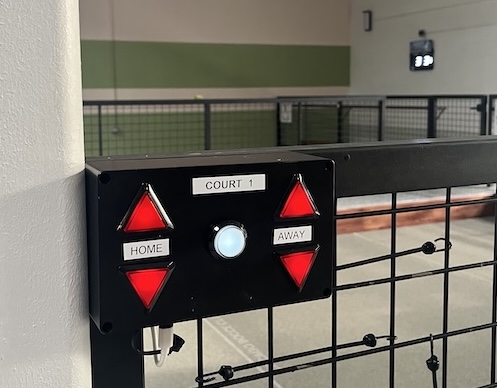
Finished!
...or is it?
Envision a connected bocce club
You might be thinking: scoreboard, buttons, Bluetooth...
Who cares?
At face value, you're probably right. Scoreboards come in forms like flip cards, peg boards, dials, and more. And honestly those are less distracting than a fancy LED sign or TV anyways.
That said, a connected scoreboard is one puzzle piece as part of a larger vision.
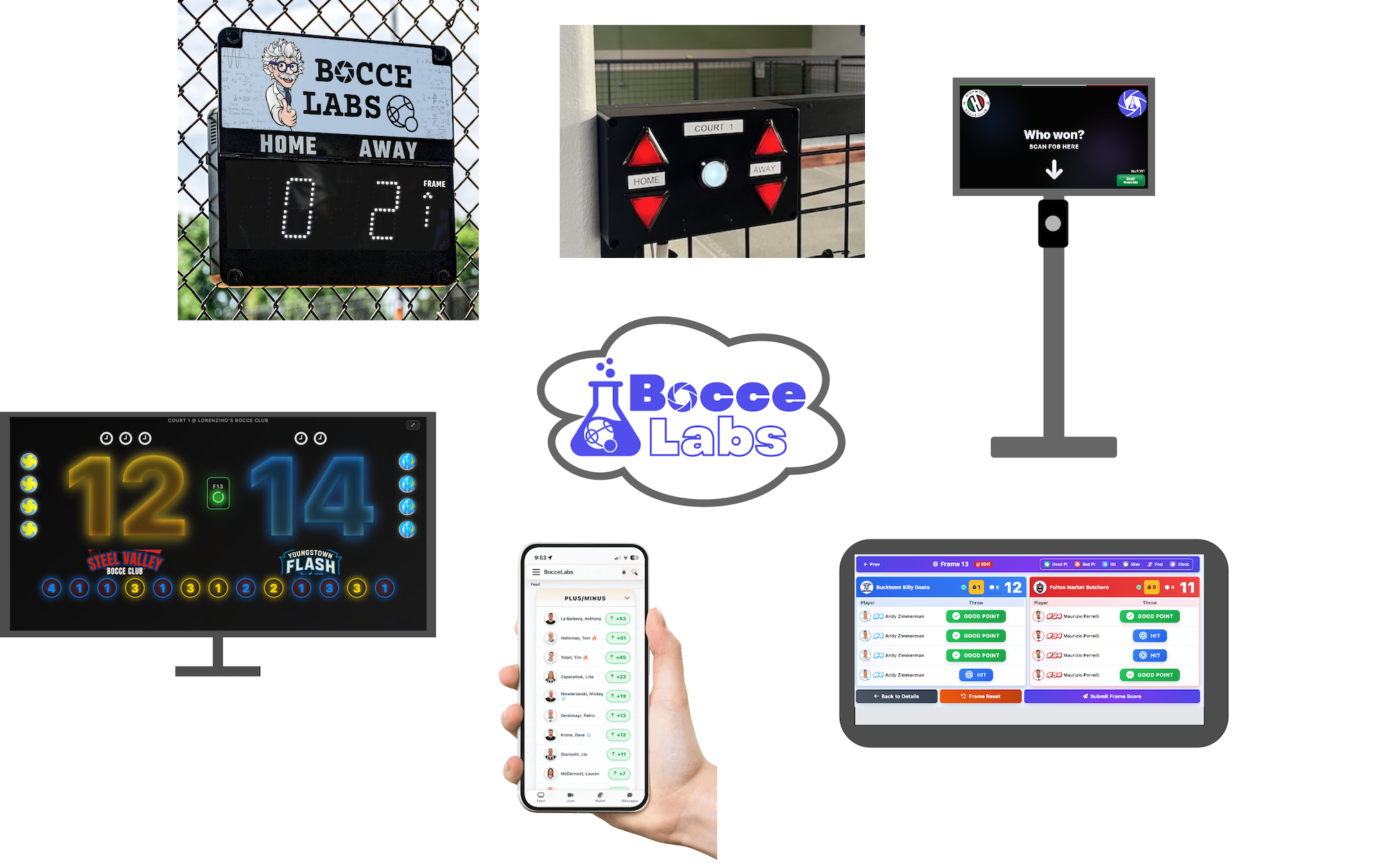
Imagine scoring a bocce game once and having an update from the statskeeper tablet flow everywhere:
- Our game database in the cloud and available on BocceLabs.com
- Montucky sponsored scoreboards
- BocceLabs TV-based scoreboards
- BocceLabs powered BBN YouTube scoreboard overlay in the corner of the livestream
- The smartphone in your pocket
Instead of a person physically updating the score in 5-6 places for players and fans on and off site, now we have centralized control as part of the BocceLabs ecosystem.
What's next?
Again, we didn't build the scoreboard. We didn't build its iPhone app.
But by understanding wireless communication protocols, we were able to take hardware designed for baseball and turn it into another building block for connected bocce.
And that's exactly the kind of project we like working on in the lab.
We prefer software, but we aren't afraid of building custom circuitry where required.
Give us a ring, ping, or ding if your club needs something integrated: team@boccelabs.com.
Roll on,
Digital Dave